Design of a distributed power system using solar PV and micro turbine-based wind energy system with a flywheel energy storage
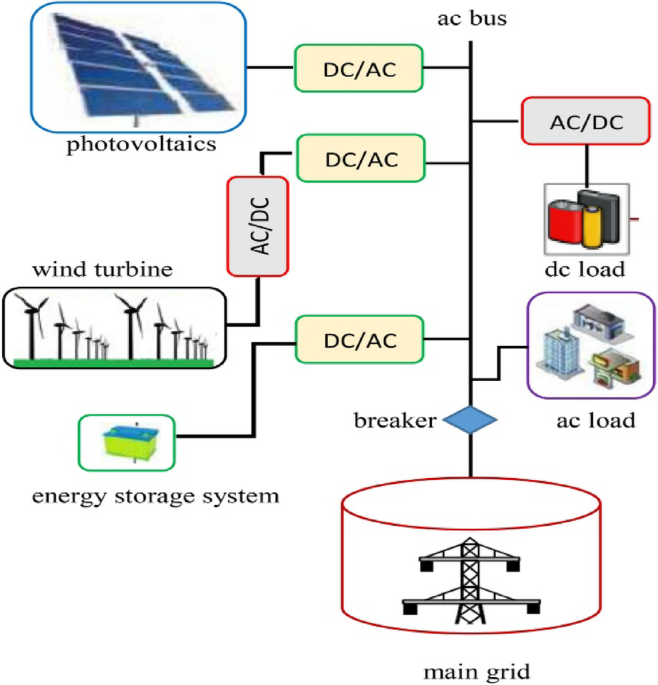
PV-based MGs, the system is implemented using MATLAB by way of a model that simulates what happens when it is all together—photovoltaic (PV), micro-turbine, and flywheel; all these disparate component systems are accounting for their dynamics, figured out as possible interactions. In MATLAB, a modular representation can be created to model each subsystem that allows for examining influences on the behaviours of the individual powertrain and system performance. To design the PV system, MATLAB provides tools to model the photovoltaic array (including parameters such as solar irradiation level, temperature effects, and electrical characteristics of panels). Modelling of the micro-turbine module can be performed using suitable data models considering wind speed, turbine efficiency, and dynamic modelling for the generator. Finally, another feature of MATLAB is the ability to model energy storage systems, enabling us to use this tool for representing how the flywheel behaves in that MG. In MATLAB, you need to connect the several blocks that represent PV arrays, micro-turbines and flywheel storage in an integrated system model as well as implement the control strategies. A similitude strategy can’t accomplish this, yet MATLAB itself gives several functionalities intended for modelling state space matrices from linear algebra (using transfer functions) via specifying “subsystem” outputs regarding certain inputs concerning other subsystems, in addition to corresponding multiplicative/connection/matricial properties. This allows for a holistic examination of how well the high penetration, real-time renewable MG is able to utilise its available sources as well as deal with inherent variations and disturbances while ensuring stability in operation18,19,20.
PID controller
A Boost Converter with a PID (Proportional-Integral-Derivative) controller is designed in MATLAB using Simulink, a powerful tool for modelling, simulating, and analysing dynamic systems. The Boost Converter is a type of DC–DC converter that steps up (increases) the input voltage to a higher output voltage, making it suitable for applications where a higher voltage is required from a lower voltage source. In the Simulink model, the Boost Converter circuit consists of essential components such as an inductor, a diode, a capacitor, and a switch (typically a MOSFET). The input voltage is supplied to the inductor, and the switch controls the energy transfer to the load. The output voltage is controlled by adjusting the duty cycle of the switch, which is where the PID controller comes into play. The PID controller is implemented to regulate the output voltage by comparing the desired reference voltage with the actual output voltage. The controller adjusts the duty cycle of the switch in real-time to minimize the error between the reference and actual voltage. The PID controller parameters—Proportional (P), Integral (I), and Derivative (D) gains—are fine-tuned to achieve the desired response, ensuring stability, fast transient response, and minimal steady-state error. In the Simulink environment, the Boost Converter model is constructed using blocks representing the physical components and mathematical functions. The PID controller is designed using a PID Controller block, where the gains are set either manually or through an auto-tuning process. The entire system is then simulated to observe the dynamic response of the output voltage, demonstrating how effectively the PID controller maintains the desired output despite variations in load or input voltage, as shown in Fig. 4. This Simulink model serves as a valuable tool for understanding the behaviour of the Boost Converter and the impact of the PID controller on its performance, allowing for further optimization and testing under different conditions.

Voltage, current, and power of PV system with DC–DC converter with PID controller.
Fuzzy controller
The Simulink model, illustrated in Fig. 5, depicts a microgrid configuration featuring a PV power generation model. This model is intricately linked to a single-phase protection diode, enhancing the system’s resilience and safety measures. The combination of both alterable and constant radiation inputs advances and enriches the model’s refinement, allowing for an overall assessment of the MG’s performance under changing environmental conditions.

Proposed system with fuzzy controller.
This layout not only warrants the studies of self-behaviour of the PV power generation models but also prospects their collaborative impact on the comprehensive system dynamics. The associated nature of these components within the Simulink model makes a smooth pathway for scrutiny of the MG’s feedback to changing PV radiation and magnifies our understanding of its usable characteristics19,21.
Figure 6 demonstrates the voltage and current waveforms at the output of the (PV) system. The voltage waveform outlines the change in electrical potential over time, reviewing the alternating cycles of energy generation from the PV panels. Figure 7 shows the fuzzy membership functions applied to the system.

Voltage and current waveform at PV output with fuzzy controller.

Fuzzy membership function plots.
Figure 8 depicts the voltage, current, and power waveforms at the DC–DC converter side of the (PV) system. The voltage waveform shows us the changes in electrical potential at the output side of the DC–DC converter over time. This waveform is important for forming an opinion on the stability of the voltage supply, making sure it meets the essential specifications for downstream components. Figure 9 depicts the voltage, current, and waveforms at the DC–AC converter side of the (PV) system.

Voltage, current, and power waveform at the DC–DC side of PV with fuzzy controller.

Voltage, current waveform at DC–AC side of PV with fuzzy controller.
A collection of group variables defines a wind turbine model. Consequently, one of these symbols is the generator speed, which is represented as an input variable and measured in units. The operating principle of the wind turbine is based on its capacity to generate mechanical power by converting kinetic energy into mechanical force, as calculated throughout. In this manner, it becomes possible to emphasize the relationship between the wind turbine dynamic properties and the performance of the PMSG, and, as a result, the RES can be successfully interlinked with the system, as it is in Fig. 1022,23.

MATLAB model of a wind energy system with a DC–DC converter.
In Fig. 11, the voltage and current waveforms at the wind turbine output are shown, providing a detailed look into the electrical characteristics of the wind energy conversion system. The voltage waveform describes the variation in electrical potential produced by the wind turbine over time, reflecting the intermittent nature of wind energy.

Voltage and current waveform at wind output.
Figures 12 and 13 reflect the voltage and currents of the Wind system converter. Since MATLAB provides the users with tools and libraries for modelling mechanical systems, it is possible to describe the action of the flywheel in terms of converting its kinetic energy and subsequently storing it in the form of electrical power through a bidirectional power converter. Key parameters of such a system would be the moment of inertia of the flywheel and its corresponding speed of rotation, as shown in Fig. 14. In conclusion, the described approach would enable a detailed evaluation of the flywheel energy storage’s operation, providing valuable information for assessing the viability of such technology in minimizing energy fluctuations within the MG23,24.

Voltage, current waveform at DC–DC side of wind system.

Voltage, current waveform at DC–AC side of wind system.

MATLAB model of the Flywheel energy system with DC–DC converter.
Figure 15 illustrates the displacement waveform at the flywheel, providing a detailed representation of the rotational movement of the flywheel over time. The displacement waveform showcases the variations in the flywheel’s angular position, reflecting the continuous spinning motion initiated by the stored kinetic energy. Figures 16 and 17 reflect the waveforms of the inverter side of the flywheel storage system25,26.

Displacement waveform at Flywheel.

Voltage, current waveform at DC–DC side of flywheel system.

Voltage, current waveform at DC–AC side of flywheel system.
Performance analysis and comparison
PID Controller-based system: As shown in Fig. 4, this system exhibits faster responses but is less stable, with higher oscillations and reduced voltage, current, and power, compared to the fuzzy system when renewable input changes suddenly.
Figure 4 depicts the voltage, current, and power waveforms at the DC–DC converter side of the (PV) system, the entire system is then simulated to observe the dynamic response of the output voltage, demonstrating how effectively the PID controller maintains the desired output despite variations in load or input voltage. The output voltage is controlled by adjusting the duty cycle of the switch, which is where the PID controller comes into play. The PID controller is implemented to regulate the output voltage by comparing the desired reference voltage with the actual output voltage. The controller adjusts the duty cycle of the switch in real-time to minimize the error between the reference and actual voltage. The PID controller parameters: Proportional (P), Integral (I), and Derivative (D) gains are fine-tuned to achieve the desired response, ensuring stability, fast transient response, and minimal steady-state error. In the Simulink environment, the Boost Converter model is constructed using blocks representing the physical components and mathematical functions. The PID controller is designed using a PID Controller block, where the gains are set either manually or through an auto-tuning process.
Fuzzy Results As shown in Fig. 7 smoother responses, reduced oscillations, better voltage, current and power under uncertainties are observed.
Figure 7 depicts the voltage, current, and power waveforms at the DC–DC converter side of the (PV) system. The voltage waveform shows us the changes in electrical potential at the output side of the DC–DC converter in course of time. This waveform is important for forming an opinion for the stability of the voltage supply, make sure it meets the essential specifications for downstream components.
The comparison of characteristic features of PID and Fuzzy is shown in Table 1.
The performance comparison between a DC–DC converter fed with a PID (Proportional-Integral-Derivative) controller and a Fuzzy controller, as presented in Table 2, highlights the differences in key operational parameters such as voltage, current, power, settling time, rise time, and ripple percentage. The output voltage with the PID controller is recorded at 1520 V, while the Fuzzy controller achieves a slightly higher output of 1570 V. Similarly, the current is 25.6A with the PID controller and increases to 26.9A with the Fuzzy controller. This indicates that the Fuzzy controller is more effective in boosting both voltage and current, thereby enhancing the converter’s performance. The power output, calculated as the product of voltage and current, shows a notable difference between the two controllers. The PID controller delivers 3.9 × 10⁴ W (or 39,000 W), whereas the Fuzzy controller provides a higher output of 4.1 × 10⁴ W (or 41,000 W). This suggests that the Fuzzy controller can extract and deliver more power from the converter, making it more efficient in terms of energy conversion27. When analysing the dynamic response, the Fuzzy controller outperforms the PID controller in both settling time and rise time. The settling time, which is the time taken for the output to stabilize within a certain percentage of its final value, is shorter with the Fuzzy controller at 0.22 s compared to 0.35 s with the PID controller. Similarly, the rise time, which measures how quickly the output reaches its final value from a specified initial value, is faster with the Fuzzy controller at 0.19 s versus 0.31 s for the PID controller. These results demonstrate that the Fuzzy controller provides a quicker and more responsive control, leading to faster system stabilization. Ripple, representing the variations in the output voltage and current, is another crucial performance metric. The PID controller exhibits a ripple percentage of 7%, whereas the Fuzzy controller reduces this to 3%. Lower ripple is desirable as it indicates a smoother and more stable output, which is particularly important in sensitive electronic applications. The Fuzzy controller’s ability to minimize ripple further underscores its superiority in ensuring a stable and consistent production.
link