Could space technology help address Montreal’s family doctor shortage?
Based on technology developed for the Canadian Space Agency, a new pilot project is intended to help identify medical conditions that need attention among people on the wait list for a GP.
Article content
A Montreal health authority is hoping that technology developed to help astronauts monitor their health in space will help it improve care for people who are on the waiting list for a family doctor.
Article content
Article content
Dan Gabay, the CEO of the CIUSSS de l’Ouest-de-l’Île-de-Montréal, said that with more than 20,000 people in Montreal’s West Island on the waiting list, the new technology is intended to help identify which of those people are healthy, and which ones may have undetected conditions that need attention before they get worse.
Advertisement 2

Article content
“This is a way for us to basically cut into the curve and give an access point and insight to patients who in appearance could be healthy, but may not be,” he said in an interview.
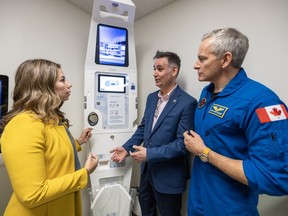
The system — based on technology developed for the Canadian Space Agency by Edmonton-based company Baüne, which has adapted its platform for a clinical setting on Earth — uses a kiosk that can take a number of vital signs from a patient, as well as ask health screening questions, like whether a patient smokes.
That data is then fed into a dashboard that can be monitored by a nurse or other health-care professional in real time, and the system can also alert a professional to potential health concerns.
The data becomes part of the patient’s digital health record and, over time, the system’s artificial intelligence can flag changes that might indicate underlying health problems.
Gabay said he wants to give healthy people reassurance, while ensuring those who are at risk can see a doctor more quickly. If the system works, he hopes patients without a family doctor would be able to use it for a screening every six months.

Today’s One Read
Article content
Advertisement 3
Article content
“The objective really is to be able to give access to routine reviews through different health-care workers, to ensure that patients aren’t caught in a gap and are able to have their health status monitored, with front-line intervention from a preventive health-care perspective,” he said.
The pilot project will start with a single kiosk at the CLSC de Pierrefonds. Nurses will be available to see patients whose screenings show potential issues, and doctors working in the Lakeshore General Hospital’s family medicine group will see patients who need further care or assessment.
If the pilot project is successful, more kiosks could be deployed, including in places where a nurse isn’t on site, such as pharmacies, Gabay said.
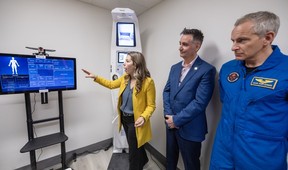
Canadian astronaut David Saint-Jacques said that astronauts need to be able to monitor their own health because a doctor isn’t always on board during space missions. He said the monitoring is becoming more important for upcoming moon missions and potential missions to Mars, where the distance will lead to delays on video calls with doctors and coming back to Earth — which is difficult but possible from the International Space Station — may not be an option.
Advertisement 4
Article content
Saint-Jacques, who is also a physician, said that by testing the system with thousands of people in Montreal’s West Island, rather than just Canada’s four active astronauts, he hopes it can be further improved.
It’s not the first time technology developed for space has been adapted for use on Earth, he said.
“Because going to space is so difficult and the requirements are so extreme, it is a great spark for innovation,” Saint-Jacques said. “We end up scratching our heads a bit harder than we would otherwise, and then, lo and behold, once we have figured things out for the excuse of space, then we have them on Earth. The whole of modern computing was basically developed for the Apollo program, for the excuse of going to the moon.”
Andrea Galindo, the CEO and co-founder of Baüne, said what distinguishes her company’s system from others is that it brings all the health data it gathers together in a single platform.
“It’s not necessarily about one medical device, but rather the connectivity of multiple devices, reducing the silos that exist in the health-care system,” she said.
As an engineer, she said, designing for space was something she dreamed about, but now she’s most proud of the fact that her technology could have an impact for everyday people.
Recommended from Editorial
-

West Island health authority using AI to offer more varied menus to patients
-

Watch: David Saint-Jacques returns to Earth after record-setting time in space
-

Brownstein: Saint-Jacques comes down to Earth, on COVID front lines
Advertisement 5
Article content
Article content
link