



The results of technological experiments conducted at China’s Tiangong space station, the state-level space lab, have been found successful application, said a technician of China Aerospace Science and Technology Corporation (CASC) in Beijing.
Since the space station’s official operation in 2021, over 100 scientific and application projects have been carried out in orbit, achieving significant progress.
Conducting space technological experiments is an important part of space station’s application projects. It is aimed at the technical verification needs of major national projects and the forefront of space technology development, and provides strong technical support for the future development of China’s space technology and space applications.
In October 2022, the space technology basic test cabinet for conducting technological experiments was sent into orbit with the Mengtian lab module, offering standardized mechanical, electrical, thermal and information interfaces for various types of on-orbit payload tests, and supporting the implementation of various test projects.
“We are currently conducting relevant research work on new technologies common to spacecrafts, including new energy propulsion technology and environmental control and life support system technology. Specifically, we have carried out experimental verification of related technologies for space thermal management, verified long-term space microbial prevention and control technologies, new energy conversion technologies, and new in-situ food regeneration technologies,” said Guo Pei, technician of China Aerospace Science and Technology Corporation.
How to rely on the powerful test platform of the space station to quickly transform the most advanced technologies and meet requirements and plans of tests, complete in-orbit verification, and obtain data is what scientific researchers are pursuing. “We have paid great attention to it from the early stages of project, including conducting a large number of design briefings, requirements briefings and design iterations with the scientific and technical teams and engineering teams of all parties in the early stage, striving to complete the design together in the first half of the task and laying foundations for the experimental planning and test plans. We will make sure that the research and development will go through smoothly so that continuous innovative test goals and technical goals can be achieved very quickly,” she said.
Over the past two years, researchers have made significant progress in multiple technical research directions, including completing China’s first in-orbit test of liquid metal space thermal management and the first in-orbit test of Stirling thermoelectric conversion, establishing the world’s first high-throughput in-orbit microbial risk prevention and control device, using targeted heating technology for the first time to change liquid microalgae from “raw” to “cooked.”
Relevant technological achievements have been promoted and transformed into space technology and civilian industries.
“Through real-time in-orbit evaluation, we can also provide very accurate data for the future selection of spacecraft materials. The in-orbit cultivation and maturation of microalgae in the space, is expected to verify its potential as food in the future. We currently have made many attempts in space thermal management in terms of civilian applications, including in the heat dissipation of laptops and some powerful module heat dissipation,” she said.


Technological results of space station experiments applied: technician
The year 2025 got off to a good start for fishermen and seafood farmers in Sichuan and Jiangsu with a bumper harvest of aquatic products on the New Year’s Day.
Fishermen gathered at Shengzhong Lake in Nanchong City of southwest China’s Sichuan Province early Wednesday morning to engage in the first fishing activity this year.
The freshly-caught fish were transferred to a transport ship before being sent to the shore for sorting and weighing.
Many businesspeople traveled a long way to the lake to buy the fish which have a long-standing reputation for good taste.
“We have been buying organic fish grown in Shengzhong Lake for many years. Their meat is tender and delicious. We sell a lot of the fish every day, usually 1,000 to 1,500 kilograms a day,” said He Dengquan, a buyer from Guangyuan City in Sichuan.
Meanwhile, fishermen in the coastal city of Lianyungang in east China’s Jiangsu Province returned from the sea, bringing back this year’s first batch of seafood including mantis shrimps and swimming crabs to Ganyu District early Wednesday morning.
The fishermen started sorting the aquatic products as soon as they moved their harvest to the shore.
“In the Yellow Sea, we caught more than 150 kilograms of conchs, more than 100 kilograms of swimming crabs, and more than 50 kilograms of mantis shrimps,” said Liang Yongtuan, a fisherman.
In Lianyun District of Lianyungang, 8,000 hectares of oysters are ready for harvest.
At a farm, oysters have become plump after more than three months of growth. Farmers have been busy pulling up cages of oysters onto boats.
“We grow oysters across this 666.67 hectares of sea, with an output of about 8.5 million kilograms. We have been harvesting the oysters and selling them to the market. This year we began harvesting a little later than last year, while the oyster’s quality and price are very good,” said Lin Bo, an oyster farmer.
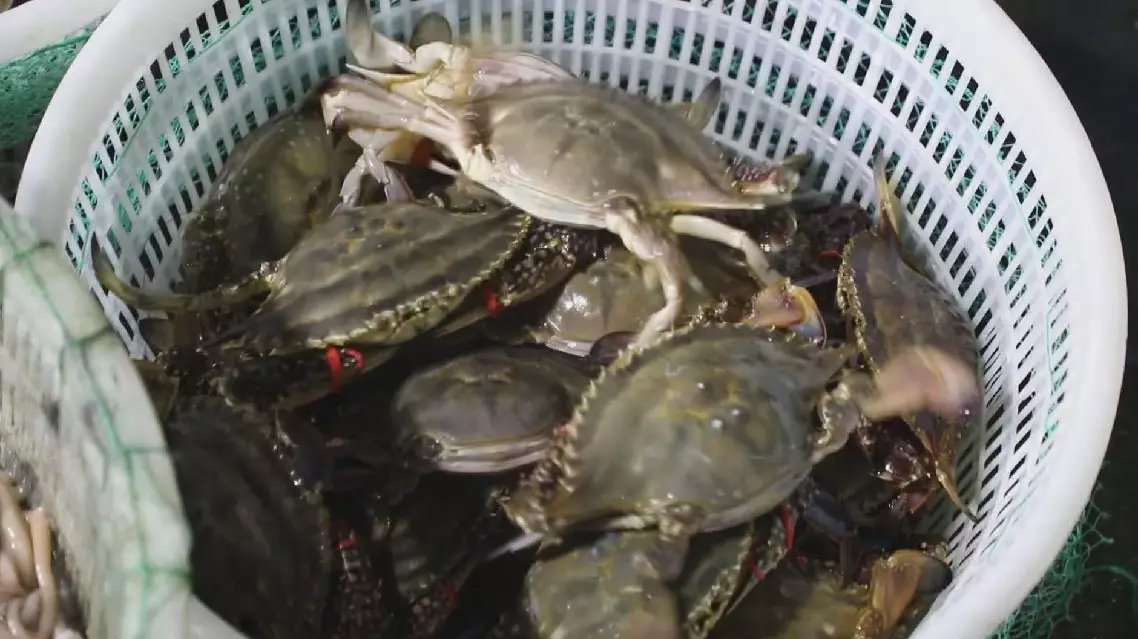
Fishermen, seafood farmers embrace new year with good harvest in Sichuan, Jiangsu
link