


Landman, a new TV series from Yellowstone writer Taylor Sheridan, includes examples of false and misleading writing about renewable energy and climate change technology, Newsweek‘s Fact Check team has discovered.
The show, streaming on Paramount+, stars Billy Bob Thornton as a crisis manager in the Texas oil industry. The cast also includes Demi Moore, Jon Hamm, Michelle Randolph, Ali Larter and Jacob Lofland.
While reviews among critics and audiences have been mixed, the show’s debut episode, released on November 17, scored 14.6 million viewers during its first seven days across its streaming service and linear premiere, TheWrap reported, making it the biggest global premiere week for a Paramount+ original show.
A scene in a later episode has also been a hit with conservatives, going viral on social media.


Billy Bob Thornton as a crisis manager for the oil industry in Taylor Sheridan’s “Landman.” The show, which has attracted a large audience, perpetuates falsehoods about the energy industry.
Emerson Miller/Paramount+
In episode three, Thornton’s character, Tommy Norris, invectively describes the lifespan of renewable energy tech to attorney Rebecca Falcone, played by Kayla Wallace.
After Norris drives Falcone to take a look at a wind farm up close, he says: “Do you have any idea how much diesel they have to burn to mix that much concrete?
“Or make that steel and haul this s*** out here and put it together with a 450-foot crane? You want to guess how much oil it takes to lubricate that f****** thing, or winterize it? In its 20-year lifespan, it won’t offset the carbon footprint of making it.
“And don’t get me started on solar panels and the lithium in your Tesla battery.
“And never mind the fact that if the whole world decided to go electric tomorrow, we don’t have the transmission lines to get the electricity to the cities. It would take 30 years if we started tomorrow.”
Norris also claimed that oil giants such as Exxon Mobil would have built more wind farms if they saw their benefit.
On TikTok and X, formerly Twitter, right-leaning users and commentators have shared the clip numerous times.
Bonchie, a writer at RedState, wrote on X, “Every left-winger should have their eyes held open and be forced to watch this on repeat until it sinks in.”
The post has been viewed 21.6 million times, and similar posts have likewise received millions of views on the platform.
On December 2, the official TikTok account for Landman posted a longer version of the clip.
While audiences may expect Norris to defend the oil industry, which may make him an unreliable narrator, what he says in the scene is not forcefully challenged. The scene also doesn’t invite the audience to question or doubt his claims. Sheridan’s writing in other projects is peppered with similar polemics.
Landman is by no means an apology letter or puff piece for the oil industry, as it depicts industrial corruption and the inherent human danger involved in drilling.
However, as Newsweek discovered, most of what Norris said in the viral scene was either false or deeply misleading. Newsweek has contacted media representatives for Taylor Sheridan and Paramount for comment via email.
“In its [wind farms’] 20-year lifespan, it won’t offset the carbon footprint of making it.“
This is not true.
Research on this topic has repeatedly found that wind energy recoups the carbon footprint it creates within a matter of months, not years—certainly well within its lifetime.
Research from 2016 in the Journal of Fundamentals of Renewable Energy and Applications found that while turbines with a large kilowatt output may have a greater “embodied carbon output,” referring to the emissions created during construction, the greater the amount of energy a turbine produces, the quicker its offset. Researchers reported a 64-day offset for a 3.4-megawatt turbine compared to 354 days for a 100-kilowatt one.
Research from 2024 published in the Journal of the Royal Society of New Zealand assessed a 176-megawatt wind farm, comprising 41 turbines, and found that the plant recouped its energy costs in half a year, with a greenhouse gas (GHG) payback of 1.5 to 1.7 years. The report did, however, note the difficulty in recycling the turbines at the end of their lifetime.
A 2019 study published in Environmental Science & Technology assessed 4,161 wind turbines built over 35 years and determined how long it took for GHGs emitted during the construction and use of a turbine to equal the total GHG savings from replacing a fossil fuel energy source with wind. The payback time varied from 1.8 to 22.5 months, averaging at 5.3 months.


Kayla Wallace as attorney Rebecca Falcone. She comes up against Tommy Norris’ invective on wind power in the third episode of “Landman.”
Emerson Miller/Paramount+
Newsweek spoke with a group of experts on renewable technology and carbon offsetting, all of whom said the offset of wind farm production was a matter of months, not years.
Alasdair McDonald, a professor in the Institute for Energy Systems and Mechanical Engineering Discipline at the University of Edinburgh, told Newsweek: “Billy Bob Thornton is very good at portraying a common character that one meets when talking about wind energy; unfortunately, that character is misinformed and wrong.”
McDonald said that Vestas, one of the world’s leading turbine manufacturers, had publicly available life cycle assessments of its turbines, including the time it takes to offset its initial carbon cost.
For a medium-size wind farm—which would be slightly smaller than most wind farms in Texas, where Landman is set—Vestas said the payback of energy involved in the manufacturing, operation, service and disposal of a 2-megawatt turbine, in medium wind, would be about seven months, and it would return initial energy output 35 times over 20 years.
“For a good Texan wind farm, I’d expect the farm to operate for longer, and the energy production to be higher, so I’d treat that 35 times as a lower bound,” McDonald added.
Vestas’ data showed that for every 1 kWh of energy produced, it needed about 0.09 megajoules of primary energy.
“For one turbine that would be 15,121,800 MJ of primary energy resource—that’s about 103,206 U.S. gallons of diesel equivalent,” McDonald said.
“It sounds like quite a big number, but quite small when you will generate energy worth 3,612,223 U.S. gallons of diesel equivalent over 20 years,” he added.

Paulina Chavez, Michelle Randolph, Billy Bob Thornton, Demi Moore and Ali Larter at the Los Angeles premiere of “Landman” on November 12. The new Taylor Sheridan series has been a hit.
UNIQUE NICOLE/AFP via Getty Images
Cristina L. Archer, the director of the Center for Research in Wind at the University of Delaware, echoed these findings: “My understanding is that it takes at most two years for a wind turbine to completely offset all of the carbon that was used to create it and maintain it.
“Including everything—the concrete, the crane, the lubricants. Obviously, there is a spread that depends on where the turbine was made. If in China, it’s probably two years. If in Europe, probably one year.”
Mark Z. Jacobson, a professor of civil and environmental engineering and the director of the Atmosphere/Energy program at Stanford University, told Newsweek: “The energy payback time of a wind turbine even 15 years ago was 1.6 to 4.3 months, nothing close to what is claimed [in Landman].
“Thus, a wind turbine (with a 30-year lifetime) is 98.8 to 99.6 percent carbon-free. Even with a 20-year lifetime, the payback time ranges from 4.2 to 6.4 months, making it 98.2 to 98.8 percent carbon-free.”
Research for offshore systems also falls below the estimates given by Norris. A 2017 study in Renewable Energy that simulated the environmental impact of two offshore wind power systems found that it took 12.8 and 14.4 months to pay back the energy consumed in construction. A further four months were taken from those figures when the recycling of waste materials was added to the calculation.
“And don’t get me started on solar panels and the lithium in your Tesla battery.”
Norris made this argument, though with less specificity, as he discussed the carbon costs of building a wind farm.
According to research and experts Newsweek spoke with, this claim is also incorrect.
A 2024 comparison by the National Renewable Energy Laboratory (NREL) of solar photovoltaic systems installed in the United States assessed the carbon payback time (CPBT) of various solar farms across the country.
NREL, a national laboratory of the Department of Energy’s Office of Energy Efficiency and Renewable Energy, found that the CPBT spanned from 0.8 years to 20 years. However, the larger figure was based on a scenario where turbine technology was produced in high-carbon areas, farms were set up in locations with low irradiated energy from the sun and parts were sent to a landfill at the point of disposal.
“The benchmark system was determined to have a CPBT of 2.1 years, which is on the lower end of estimates from recent literature,” the review said.
Energy payback time varied between 0.5 to 1.2 years in the U.S., depending on supply chain and location.
Jacobson provided Newsweek with a copy of a 2008 review he authored, published in Energy & Environmental Science, that assessed the payback of technologies, including solar panels.
“Solar PV panel payback times 15 years ago were longer, 1-3.5 years, depending on the solar resource available at the location (e.g., one year would be Arizona),” Jacobson said.
“That means solar PV panels are 88.3 to 96.7 percent carbon-free,” he continued, adding, “Payback times today for both are lower due to greater efficiencies of both wind turbines and solar PV panels.”

Wind turbines at a wind farm and solar panels near Palm Springs, California. A “Landman” scene involving wind farms has gone viral on social media.
Mario Tama/Getty Images
James Manwell, an emeritus professor of mechanical and industrial engineering and the founding director of the Wind Energy Center at the University of Massachusetts Amherst, told Newsweek: “I did look into solar PV panels a few years ago and their energy payback was not as good as wind turbines, but the energy return was greater than the energy invested.
“As PV panel prices drop, which they have been doing, I expect that the energy return on investment is similarly improving.”
The payback of a lithium battery in a car depends on its manufacture and materials and the grid it’s using to recharge. A car connected to a grid that uses energy sources with more greenhouse gas output will take longer to offset the carbon footprint from its production and maintenance than one that plugs into a grid with renewable energy.
A 2018 briefing produced for the think tank the International Council on Clean Transportation said high emissions produced during an electric vehicle’s manufacture drop after two years compared to an “average conventional vehicle.”
As reported in a PolitiFact analysis from 2022, researchers estimated a break-even point for EVs of between 13,500 miles and 26,000 miles. While other research posits figures higher than these, the number is affected by how and where batteries are manufactured, their strength and the grids they are plugged into.
The environmental impact of electric vehicles is nonetheless considered better than that of conventional combustion engines. Writing in 2022, the MIT Climate Portal cited 2019 research from MIT showing that in their life cycle—including production, use and disposal—gasoline cars emit more than 350 grams of carbon dioxide per mile driven over their lifetimes. Hybrids scored more than 250 grams per mile, while fully battery-electric vehicles emitted the equivalent of 200 grams.
Even EVs that spend less time on the road still produce less carbon than other cars. The 2019 research found that EVs with 90,000 miles on the road, rather than 180,000 miles, were still 15 percent less carbon-polluting than the hybrids and gas cars studied.

A charging station for the electric vehicle company Tesla Motors in the Silicon Valley town of Mountain View, California, on August 24, 2016. The environmental impact of electric vehicles is considered better than that of conventional combustion engines.
Smith Collection/Gado/Getty Images
“And never mind the fact that if the whole world decided to go electric tomorrow, we don’t have the transmission lines to get the electricity to the cities. It would take 30 years if we started tomorrow.”
The International Energy Agency reported in 2023 that the world would have to add or replace 49.7 million miles of transmission lines by 2040 to meet global climate and energy goals, a number equal to the “entire existing global grid.”
Annual investments in grids, it added, would also have to double to more than $600 billion a year by 2030.
Many nations, including the U.S., have committed to reaching the goal of carbon neutrality by 2050. While achieving that means more than new transmission lines, it shows that leaders, at the very least, are optimistic about creating cities capable of handling more renewable and non-fossil-fuel energy sources within 30 years.
That doesn’t necessarily mean that will happen. Jacobson said the time it will take is based on factors beyond technological or practical limits.
“The speed of a transition depends on social and political limitations, not technical or economic,” Jacobson said.
“We could transition 80 percent by 2030 and 100 percent by 2035 if we have the political willpower,” he added.
One such solution may be to use power-to-X technologies, where renewable energy is converted into a type of electrical fuel, as Manwell told Newsweek.
“Building transmission lines is indeed a challenge, but the difficulties are at least as much social and political as they are technical,” he said.
Manwell added: “Getting close to 100 percent solar and wind is also a challenge and likely will require use of synthetic fuels, based on hydrogen from electrolysis. This is the subject of what is known as ‘power-to-x’ and is a topic that could be of interest to the oil companies. Much of the technology is similar.
“I presume that the oil companies like oil now because it’s very profitable for them.”
“Believe me, if Exxon thought them f****** things [windmills] right there were the future, they’d be putting them all over the g****** place.”
This appeal to authority fallacy bets on the idea that because an energy giant such as Exxon Mobil has not invested more in wind farms or renewable technology, wind farms are therefore not a reliable energy producer. It suggests Exxon has not invested significantly in wind farming solely on the virtue of the technology without considering other motives, such as profit or cost cutting.
As reported by climate journalists at Grist, within the past three years, Exxon and other major oil producers have pulled back on emissions and renewable energy projects as their profits from barrels of oil sold have soared. While rolling back green projects may have been driven by factors beyond profitability, Landman omitted the influence entirely.
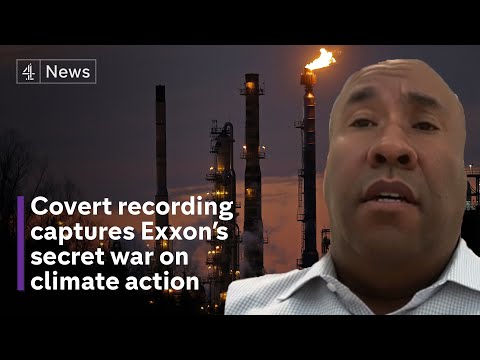
Exxon Mobil, Shell and BP have also contributed to lobbying efforts supporting oil and gas over renewable or cleaner energy. In 2021, an Exxon lobbyist was recorded on camera saying the company had “aggressively” fought climate science.
“Did we aggressively fight against some of the science? Yes. Did we hide our science, absolutely not,” lobbyist Keith McCoy told an undercover reporter working for Greenpeace.
He added: “Did we join some of these ‘shadow groups’ to work against some of the early efforts? Yes, that’s true. But there’s nothing illegal about that.
“You know, we were looking out for our investments. We were looking out for our shareholders.”
The “shadow group,” as reported by Greenpeace’s journalism outlet, Unearthed, was likely related to the network of think tanks and other groups influencing political action on climate change.
Exxon said McCoy’s comments did not represent the company’s views and were “inconsistent with the way we expect our people to conduct themselves.”
“We were shocked by these interviews and stand by our commitments to working on finding solutions to climate change,” it added.
McCoy, who apologized on LinkedIn, left Exxon later that year.
Furthermore, companies like Exxon have spent decades investing in oil-driven infrastructure and delivery, not wind farms, solar energy or other renewable technology, Jacobson said.
“Exxon has no expertise in wind energy,” he continued, adding, “Wind energy companies are far superior to Exxon at building and operating wind turbines and farms.”
Archer told Newsweek: “The argument about Exxon is ridiculous. Exxon’s strategy is to look for more oil because it is their core value and because for the short term (dozens of years) they will still make profits that way. They are not an energy company; they are an oil company.”
McDonald added, “There’s still lots of money in oil and gas and will continue to be so for a while.”
“Renewables development is a different skill set and business, so it isn’t such an easy transition,” he continued.
Not all the arguments in the viral Landman monologue are based on bad science or research. At one point, Norris mentioned the many vital plastic products were created from fossil fuels.
“And unfortunately for your grandkids, we have a 120-year petroleum-based infrastructure. Our whole lives depend on it. And hell, it’s in everything. That road we came in on. The wheels on every car ever made, including yours. It’s in tennis rackets, lipsticks, refrigerators and antihistamines. Pretty much anything plastic.”
This chimed with Archer, who said it was still a valid argument “to stop burning petroleum.”
“Plastic is everywhere, and it comes from petroleum for the most part,” Archer said.
She added: “I do not think we could survive without plastic. So why burn petroleum (as gasoline/diesel, etc.) when we need it for plastic?
“I think it’s actually an argument for renewables. Let’s use them for energy and transportation and save the petroleum for plastic.”
Energy, misinformation and the Trump administration
The false claims made in Landman echo wider conservative disdain for wind and other types of renewable energy—a view held by the incoming president.
President-elect Donald Trump’s plans for energy development in the U.S. are driven by the promotion of fossil fuel extraction and the dismissal of clean energy projects, particularly wind. He previously said he would kill offshore wind energy development on Day One of his second term.
Throughout his presidential campaign, Trump spread false claims about the number of bald eagles killed by turbines. In 2019, FactCheck.org debunked claims the then-president made. Trump said turbines caused cancer and reduced the prices of nearby houses by 75 percent. The BBC similarly found no evidence for a claim Trump made in 2023 that turbines killed whales.
In May, The Washington Post reported that Trump told a group of oil executives and lobbyists that they should give his campaign $1 billion because he would end environmental rules.
According to the report, Trump said the $1 billion donation would be a “deal,” given the relaxation of taxes and regulations he would implement to their benefit.
link