Government Slashes GST on Renewable Energy Devices from 12 Percent to 5 Percent – Asia Pacific
The decision was taken during the 56th meeting of the GST Council which was held in New Delhi under the chairpersonship of the Union Finance and Corporate Affairs Minister Nirmala Sitharaman.
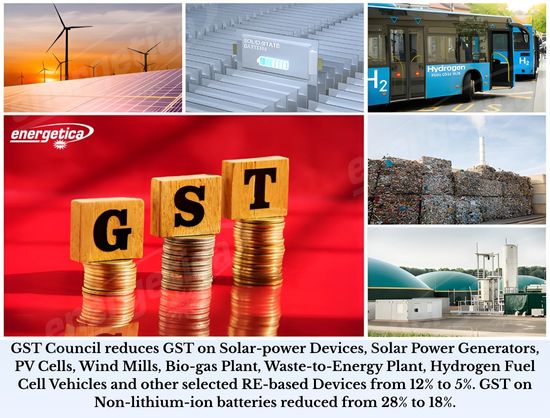
The relaxation in GST rates will be applicable to solar power-based devices, solar power generators, solar lanterns/lamps, solar cookers, solar water heaters and systems. Photovoltaic (PV) cells, whether or not assembled in modules or made up into panels will also benefit from the reduction of the GST rate.
Wind mills and wind-operated electricity generator (WOEG), bio-gas plants and waste-to-energy plants/devices have also seen the reduction in GST rate from 12 percent to 5 percent. Other categories from the renewable energy sector include ocean waves/tidal waves energy devices/plants, and fuel cell motor vehicles including hydrogen vehicles based on fuel cell technology.
The Council has also lowered the GST on non-lithium-ion batteries, including lead-acid, sodium, and flow batteries, from 28 percent to 18 percent to boost grid-scale energy storage for renewable power. The GST on lithium-ion batteries remains unchanged at 18 percent.
Prime Minister Narendra Modi hailed the move, saying, “During my Independence Day Speech, I had spoken about our intention to bring the next-generation reforms in GST. The Union Government had prepared a detailed proposal for broad-based GST rate rationalisation and process reforms, aimed at ease of living for the common man and strengthening the economy. Glad to state that the GST Council, comprising the Union and the States, has collectively agreed to the proposals submitted by the Union Government on GST rate cuts and reforms, which will benefit the common man, farmers, MSMEs, middle-class, women and youth. The wide-ranging reforms will improve the lives of our citizens and ensure ease of doing business for all, especially small traders and businesses.”
Gautam Mohanka, Managing Director, Gautam Solar, remarked, “GST Council’s decision to reduce the GST rate on solar components from 12 percent to 5 percent marks a pivotal step in accelerating India’s clean-energy transition. This significant reform greatly increases the accessibility of solar installations for households, businesses, and farmers across the country.”
With this, the government is making solar power more affordable and enabling faster adoption, which will directly help cut carbon emissions and reduce dependence on fossil fuels. “We believe this tax break will not only boost energy security and encourage new project pipelines but also contribute meaningfully to India’s climate action commitments and its global responsibility to combat climate change,” added Mohanka.
Ajinkya Firodia, Vice Chairman of Kinetic India, remarked, “The GST rate cut will give a strong boost to the economy in an unprecedented manner. Essentials, including food, automobiles, and several other key sectors, have been rightly covered under this decision. This step aligns with the vision of making India self-sufficient—an Atmanirbhar Bharat. It will lower interest rates, facilitate employment generation, and encourage capacity augmentation across industries.”
He further emphasised that the electric vehicle (EV) sector should continue to be kept in special focus. “To ensure higher penetration of EVs, especially two-wheelers, we urge the continuation of supportive schemes so that this transformative sector does not face any adverse impact. EV adoption is critical for India’s sustainable growth and competitiveness,” Firodia added.
Dhruv Sharma, CEO, Jupiter International, commented, “GST Council has taken a historic step to reduce taxes on renewable energy components to 5 percent from 12 percent. This move not only brings down the cost of solar and clean energy solutions but also energizes the entire ecosystem—manufacturers, developers, and end users alike. It will also help in India’s clean energy momentum and make sustainable solutions more accessible to millions.”
Dr. Amit Paithankar, CEO and Whole-time Director, Waaree Energies, remarked, “The reduction of GST on renewable energy devices and equipment to a uniform 5 percent will lower project costs and accelerate the capacity addition needed to meet India’s clean energy targets. It also sends a strong signal to investors, improving the financial viability and attractiveness of the renewable energy sector.”
Moreover, this development will directly help reduce the overall cost of solar modules. “Waaree is committed to passing on these benefits to customers, which will make our products more competitive in the market. While the exact reduction will depend on project specifications and configurations, customers can expect a tangible decrease in module prices, further strengthening the case for solar adoption. The move will also help expand solar adoption in households across the country, supporting the implementation of the PM Surya Ghar Yojana,” added Paithankar.
Siddharth Bhatia, MD, Oyster Renewable Energy, said, “The GST Council’s decision to reduce the tax rate on renewable energy components, including solar cells, windmill equipment, and biogas plants, to 5 percent represents a critical step forward for India’s clean energy transition. As a hybrid IPP player committed to accelerating the adoption of renewable power, this move significantly lowers the input costs for project development and module manufacturing, thereby enhancing the overall economics of renewable energy projects.”
He further added, “This tax rationalisation is particularly timely as it coincides with India’s ambitious targets for domestic manufacturing self-reliance under the Atmanirbhar Bharat initiative and the ongoing efforts to scale up green hydrogen mobility solutions. Lower GST rates will most definitely stimulate project pipeline growth by making renewable power generation more cost-competitive, thereby fostering stronger demand from distribution companies and corporate buyers alike.”
Moreover, addressing the inverted duty structure with expedited refund mechanisms will streamline liquidity for manufacturers and developers, easing cash flow and allowing faster capacity expansion. “For hybrid IPPs navigating the complexities of integrating renewables with conventional power assets, this creates an enabling environment for flexible, scalable, and financially viable clean energy portfolios,” opines Bhatia.
Rajeev Kashyap, SVP and General Manager for India, Middle East, and Africa, Nextracker remarked, “This reform will benefit developers, power producers, and consumers alike by lowering project costs, enhancing viability, and enabling faster adoption across industries and utilities. Importantly, it also strengthens the case for domestic manufacturing, supporting India’s efforts to build a resilient supply chain for critical components. More competitive and higher-yield projects will attract greater investment into the sector, fuelling India’s renewable energy ambitions. At Nextracker, we are deeply aligned with the Make in India vision, and this policy change further empowers us to scale local manufacturing of solar trackers while contributing to the nation’s clean energy goals.”
Akshay Hiranandani, CEO, Serentica Renewables emphasised that the reduction of GST on renewable energy equipment from 12 percent to 5 percent will significantly improve project cost efficiency, enabling faster deployment of clean power. “Lower capital costs will translate into more competitive tariffs in auctions, supporting quicker capacity addition and passing direct benefits to consumers,” he said.
Girish Tanti, Co-Founder and Vice Chairman, Suzlon Group commented, “The recently announced GST reforms by government shall provide immediate boost to various products and services across industries. The fiscal nudge from 12 percent to 5 percent for renewable devices shall help in accelerating adoption of renewable energy and building robust manufacturing ecosystem toward achieving our National goals of NetZero and Atmanirbhar Bharat set out by the PM.”
JP Chalasani, CEO, Suzlon Group added, “The GST reduction is a decisive step that will significantly reduce power tariffs, making clean energy more affordable for consumers and improving project economics for developers. In wind energy, lower taxation on turbines, nacelles, blades, and balance-of-plant components will cut capital intensity and the levelized cost of energy — enabling faster commissioning, stronger investor returns, and greater capacity additions. Reforms like this go beyond the energy sector; they stimulate domestic manufacturing, create thousands of jobs, and directly contribute to India’s GDP growth.”
link